



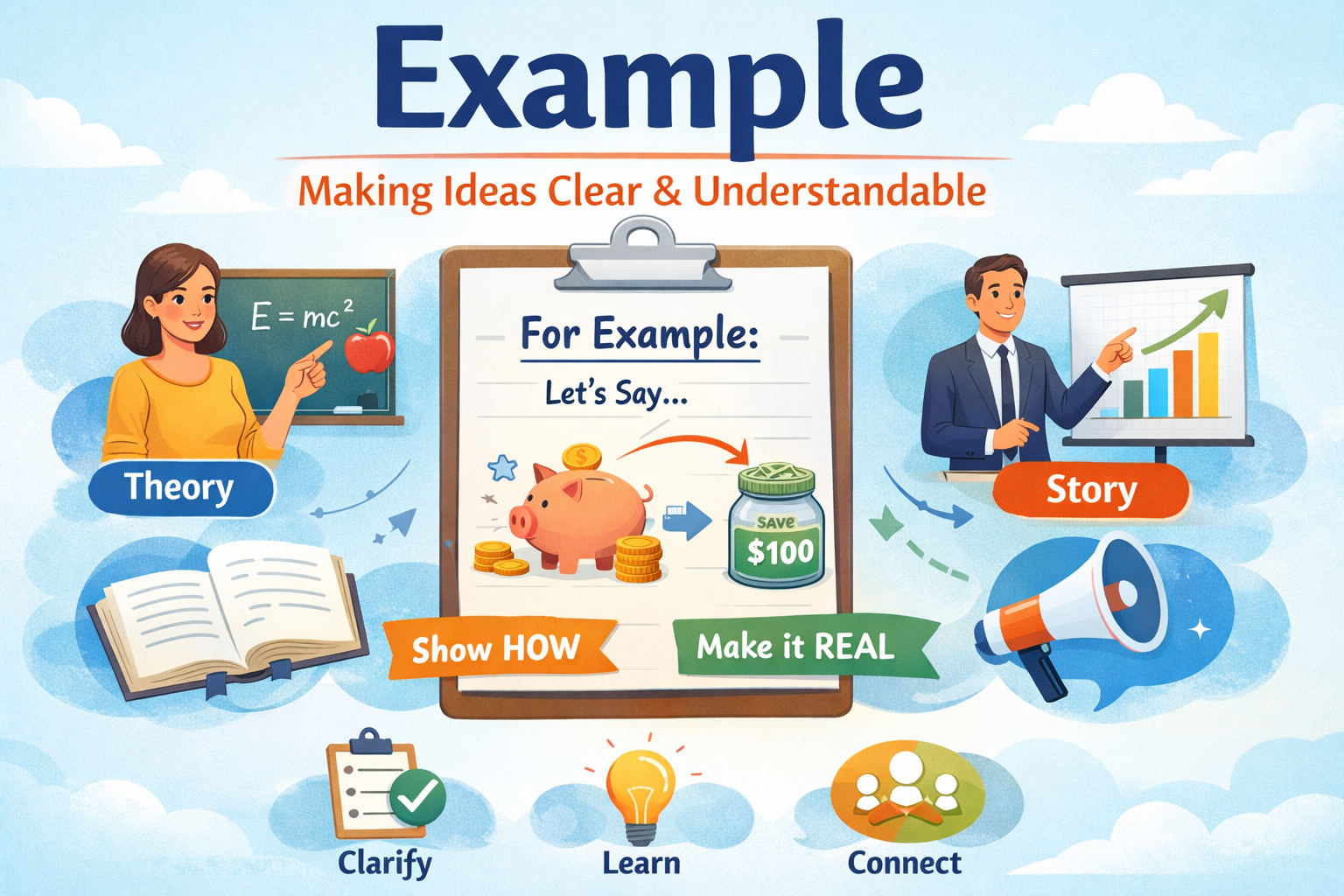
The word example is one of the most commonly used terms in education, communication, and problem-solving. Yet many people underestimate its importance. A well-chosen example can clarify complex ideas, strengthen arguments, and make information easier to understand and remember.
In this guide, we’ll break down what an example truly is, why it matters, and how to use examples effectively in real life, education, writing, and professional communication.
What Is an Example?
An example is a specific case, situation, or instance used to explain, support, or illustrate a general idea or concept.
Instead of speaking in theory, examples:
- Make ideas concrete
- Help people visualize information.
- Reduce confusion
- Improve understanding and retention.
In simple terms, an example turns abstract ideas into relatable experiences.
Why Examples Are So Important
Human brains learn best through patterns and stories. Examples provide both.
Key benefits of using examples:
- Improves clarity – Ideas become easier to understand
- Builds trust – Real examples feel more believable.
- Enhances learning – Students grasp concepts faster.
- Strengthens communication – Messages become more persuasive.
Without examples, information often feels distant, vague, or confusing.
Types of Examples Used in Everyday Life
Examples appear everywhere, even when we don’t notice them.
1. Educational Examples
Teachers use examples to explain math formulas, grammar rules, or scientific concepts.
Example:
Instead of defining gravity, a teacher explains it by dropping a book.
2. Real-World Examples
These connect theory with daily life.
Example:
Explaining budgeting by comparing income to monthly household expenses.
3. Professional Examples
Used in business, marketing, and presentations.
Example:
A company shows customer success stories to prove product value.
4. Personal Examples
These create emotional connection and relatability.
Example:
Sharing a personal failure to explain a life lesson.
How to Use an Example Effectively
Not all examples are equally powerful. The right example depends on your audience and purpose.
Best practices:
- Keep examples relevant
- Use simple language
- Avoid unnecessary complexity
- Match the example to the audience’s experience.
- Use one strong example instead of many weak ones.
A clear example is better than a long explanation.
Example vs Explanation: What’s the Difference?
An explanation tells what something is.
An example shows how it works.
Comparison:
- Explanation: Describes the rule
- Example: Demonstrates the rule in action
The strongest communication combines both.
Examples in Writing and Content Creation
In blogging and SEO content, examples:
- Increase reader engagement
- Reduce bounce rate
- Improve readability
- Make content feel human and trustworthy.
Search engines favor content that users understand, and that keeps users on the page longer. Well-placed examples naturally support this.
Common Mistakes When Using Examples
Avoid these errors:
- Using irrelevant or confusing examples
- Overloading content with too many examples
- Using examples that require too much background knowledge
- Making examples longer than the main point
An example should clarify, not distract.
How Examples Improve Learning and Memory
Studies show people remember:
- 10% of what they read
- 30% of what they see
- Up to 65% when concepts are explained with examples
That’s why examples are essential in teaching, training, and communication.
Simple Example in Action
Concept: Saving money
Explanation: Spending less than you earn helps with financial stability.
Example: If you earn $1,000 and spend $800, the remaining $200 becomes savings.
This small example instantly makes the concept clear.
When You Should Always Use an Example
Use examples when:
- Explaining new ideas
- Teaching beginners
- Writing educational content
- Making decisions easier
- Trying to persuade or convince
If clarity matters, an example.
Conclusion
An example is more than just an illustration—it’s a powerful tool for understanding, learning, and communication. Whether you’re teaching, writing, presenting, or simply explaining an idea, the right example can make your message clear, relatable, and memorable.